
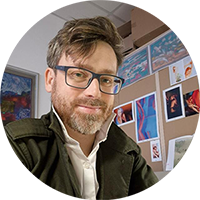
MgA. Bc. František Novotný (*1983, Liberec, Czech rep.)
František works professionally in marketing and visual communication (both in the commercial sector and in public service media) and has long been engaged in artistic practice.
He graduated with honours from the Faculty of Art and Design at Jan Evangelista Purkyně University in Ústí nad Labem, specializing in Visual Design under Associate Professor Pavel Beneš (2010). He also completed studies in Artistic Glass and Jewellery Design at the Technical University of Liberec under Associate Professor Ludmila Šikolová (2008). Prior to that, he studied at the Secondary School of Applied Arts in Železný Brod, focusing on glass design and painting.
He completed internships at the Academy of Fine Arts in Wrocław in the Painting Studio, as well as at Pilchuck Glass School in Seattle, USA.
His work has been presented in several exhibitions in the Czech Republic (e.g., Mechanics of Transcription – The Three; Experimental Studio in Liberec; Transponáty: Sample at Galerie V rámci in Ostrava, among others). In 2024, he presented the Prague exhibition Sea of Lines at the Volvox Globator publishing house. A decade earlier, he participated in collective exhibitions in the United Kingdom, including Story Thestance in: Distance Distorted at Vane Gallery, Newcastle, and No Fictional Additives at Moving Gallery. In 2026, he exhibited Tangled Hair at Czech Radio.
Alongside painting, František also focuses on authorial photography, primarily figurative and nude compositions, as well as digital montage. In some projects, he occasionally works under pseudonyms (Jonáš Bota or František Janýš).
Selected References:
https://informace.rozhlas.cz/galerie-vinohradska-12-frantisek-novotny-zacuchane-vlasy-9604427
https://www.artmap.cz/eventy/veronika-and-her-paradise-no-fictional-additives/
https://www.vane.org.uk/exhibitions/distance-zkreslena
https://www.artmap.cz/eventy/distance-zkreslena-0
https://www.krasnaostrava.cz/frantisek-janys-novotny-v-galerii-v-ramci/
https://www.artmap.cz/eventy/frantisek-novotny-krajiny/
https://advojka.cz/a2-article/2010-17-setkani-na-rozcesti/
and others
S t a t e m e n t:
— Structure
My work is based on the conviction that an image is not decoration but a field of forces. I am not interested in illustrating reality or producing aesthetic spectacle. What interests me instead is structure — the tension between line, space and the quiet energy of the image, where colour and complementary relationships act as essential agents within the composition.
I work with a reduced visual language situated on the threshold between drawing, painting and photographic perception. Lines behave like trajectories in space: at times they resemble landscapes, at other times organic structures or maps of invisible relations. The image does not describe a specific place; rather, it records a field — a kind of inner topography.
— Landscape and Body
Alongside these abstract landscapes, which reflect inner maps and elemental forces, the human body appears in my work, most often the female figure. Not as a traditional nude, but as a continuation of landscape — a metaphor of origin, womb and emergence.
The line of the body and the line of the terrain become different manifestations of the same principle: a form that connects the organic world with a cosmic order, where the inner and outer cosmos reflect one another. Micro and macro mirror each other here — processes unfolding at the scale of a cell as well as those shaping the structure of the universe.
I often work in series (diptych, tetraptych, hexaptych), where individual works function as fragments of a larger whole. Meaning does not reside in a single image but emerges between them — in rhythm, repetition and variation.
— Gravity of the Image
My process is close to analytical observation: images develop through layering and reduction, through a search for balance between control and spontaneity. The result is not a closed statement but an open visual situation.
I am not interested in spectacle or narrative illustration. What interests me is the gravity of the image — the moment when form settles and begins to act on its own.
Artist’s text:
— Tangled Hair
The exhibition installation is a visual metaphor for the intersection of inner and outer space — worlds that exist within us and around us, with us and without us. Fragments of worlds, touches that are material or merely dreamed, tangled and unravelled, loose and tightened, like hair in the wind, like threads in a sewing machine, like high-voltage cables. A place where individual states do not follow a linear order, but exist simultaneously.
The tangled structure resembles a kind of quantum foam, a kind of ferment — an irregular and shifting space at the edge of legibility. Seen up close, it speaks of microscopic interactions, minute changes and subtle forces that caused a single line, a single path, to bend. From a distance, it becomes a macrostructure whose shape emerges from the sum of countless small probabilities.
Every hair, every bend and every knot is a trace of a situation that could have unfolded differently, but at one particular moment settled into a specific form. It captures the instant when, out of an infinite number of possibilities, a single reality emerges — while still remaining open, unanchored. Every thread, every fibre, every line of force, all of this filament — like paths through a field of trajectories, a place where the individual lines of personal and collective worlds overlap, translate into one another and mutually influence each other.
Every knot is condensed time, every branching a decision, every swing a possibility that once existed and was abandoned. And found again. Or merely remembered. Through the thickness of experience, through layers of touch. Every fibre is a path that turned somewhere other than where we expected. A place where time stopped and began again, then for a moment returned, as though wanting to touch once more the same — unknown — point.
From this perspective, Tangled Hair becomes a playing field: a constantly changing map suspended in a single instant, a map that records the tension between who we were, who we are, and who we are becoming. The installation presents filament not as material, but as the imprint of the movement of the unconscious — an image that takes shape beyond our control and yet describes us with uncanny precision. And every recorded strand is another language of the same movement.
Over time, movements accumulate into a set of fractals — like mycelium spreading through the fungal network beneath the surface. Branching strengthens the whole; connections create new paths; the structure is governed not by geometry, but by adaptation. The images become an organism rather than an object. They become their own entanglement, governed by invisible relationships: every strand pulls and is pulled, every bend is a response to the forces acting upon it at that particular moment.
They function as a map of flashes from unnamed worlds, as a language of states, as blank maps of rivers, as moments that were never fully decided and yet left a trace. Mapping space. Like the topography of a landscape. Like weather. Like a body extending far beyond the skin. The rhythm of breath. Surf. Pulse.
Tangled Hair thus becomes an image in which body, nature and mind converge within a single principle: life grows through hyphae — and hyphae are never straight.
— Enki above Abzu
The exhibition Enki above Apsú (Abzu) is based on an understanding of reality as a fluid space in which past, present and future are not separated in a linear way, but continuously overlap, sediment and re-emerge in new configurations. Ancient mythological metaphors are used here neither as historical reconstruction nor as illustrations of distant stories. Instead, they become archetypal models of contemporary experience — of a world without a fixed centre, in which consciousness attempts to orient itself within shifting currents of relationships, images and meanings.
The title refers to the Sumerian principle of Enki, an intelligence immersed in the primordial depths of Apsú. Here, Enki is not understood as a divine figure, but as a principle of orientation arising from within chaos rather than outside it. The works explore the tension between latent depth and temporary structure, between organic noise and an emerging architecture of order. Lines, fragments and layers create a field that can simultaneously resemble a landscape, a body, a map, and an unreadable network of relationships.
The project follows on from the exhibition Tangled Hair, in which structures appeared primarily as indeterminate and dispersed fields of force. The new compositions continue to emerge from this layer, while at the same time beginning to expose and articulate it more clearly. From the original fluid indeterminacy, points of orientation, axes and trajectories gradually begin to surface — not as a definitive system, but as a fragile attempt to read a space whose depth remains elusive.
The exhibition reflects on the contemporary experience of consciousness: no longer trusting fixed, seemingly truthful and universal structures, yet still continuing to search for rhythm, connection and temporary order. Here, the image is not a closed representation of reality, but a process of orientation within a world that remains fluid, layered and constantly being rewritten.